Our verdict
Jupiter earns its reputation as Solana's default swap router: fees run from 0 to 10 basis points on most pairs, and its meta-aggregation genuinely finds better prices than trading on a single venue would. The same interface puts 250x leverage on SOL, BTC and ETH perps one toggle away from a basic swap, and it is fully self-custodial, so a newcomer who gets phished or over-leveraged has nobody to call.
Specs
- Platform fee, JUP/JLP/pegged pairs
- 0 basis points
- Platform fee, SOL-stable pairs
- 2 basis points
- Platform fee, LST-stable pairs
- 5 basis points
- Platform fee, most other pairs
- 10 basis points
- Platform fee, tokens under 24 hours old
- 50 basis points
- Perpetuals leverage
- Up to 250x on SOL, BTC and ETH
- Custody model
- Non-custodial; funds stay in the user's own wallet
- Mobile app rating
- 4.9/5 from over 1.1 million ratings on iOS
Ask a Solana trader where they swap and the answer is almost always Jupiter, before they name any single decentralized exchange. That is the point of an aggregator: instead of picking one venue's order book, Jupiter's routing engine checks liquidity across the network and splits or redirects an order to whichever combination of pools gives the best price. We ran swaps of different sizes through it, opened a small leveraged position on its perpetuals product, and checked the fee schedule against what actually landed in our wallet.
What a swap costs
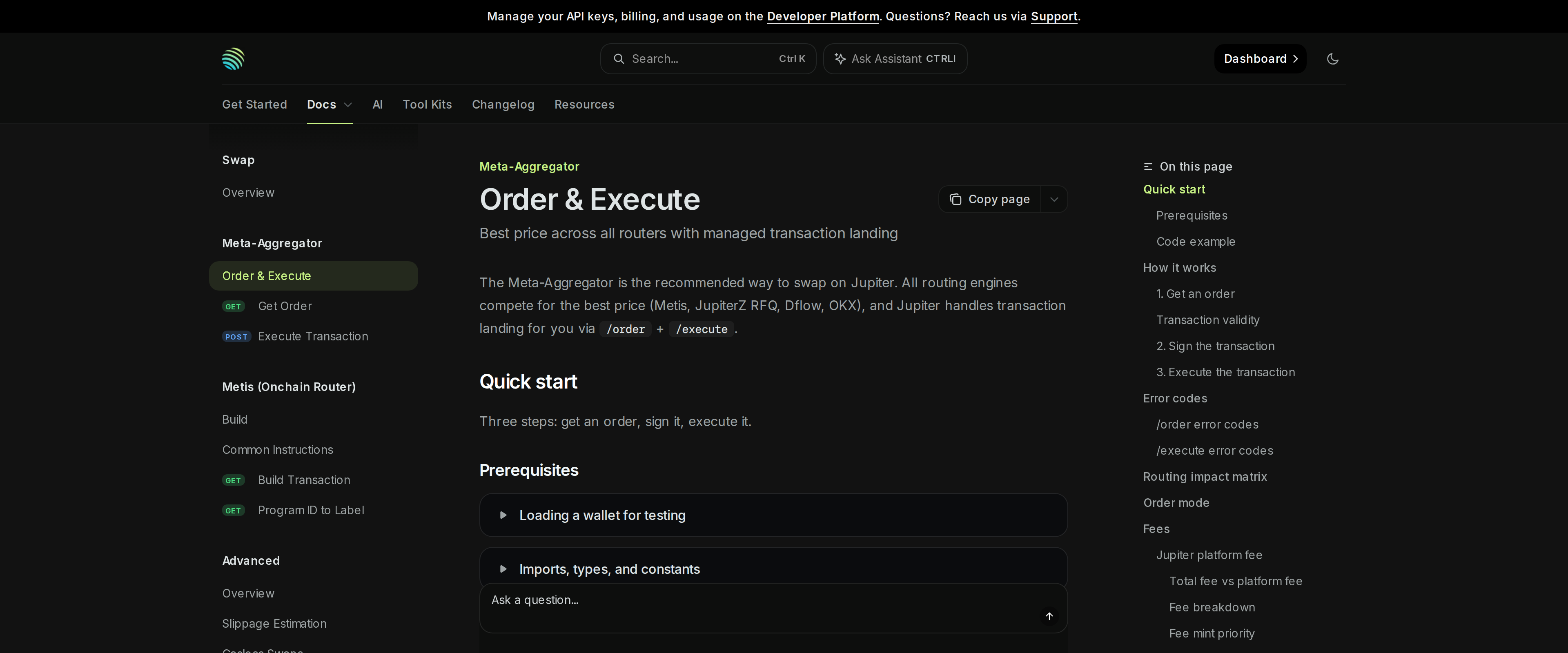
Jupiter's own documentation lays out fees by pair type rather than one flat number. Swaps between JUP, JLP or other pegged-asset pairs cost 0 basis points in platform fees. SOL-to-stablecoin pairs run 2 basis points, LST-to-stablecoin pairs run 5, and most other pairs settle at 10 basis points, roughly a tenth of a percent. Tokens younger than 24 hours carry a 50 basis point fee, which discourages some of the riskiest brand-new-token trades without banning them outright. None of that includes the separate Solana network fee, which Jupiter optimizes automatically through what it calls its Real-Time Slippage Estimator rather than leaving users to guess a slippage percentage themselves.
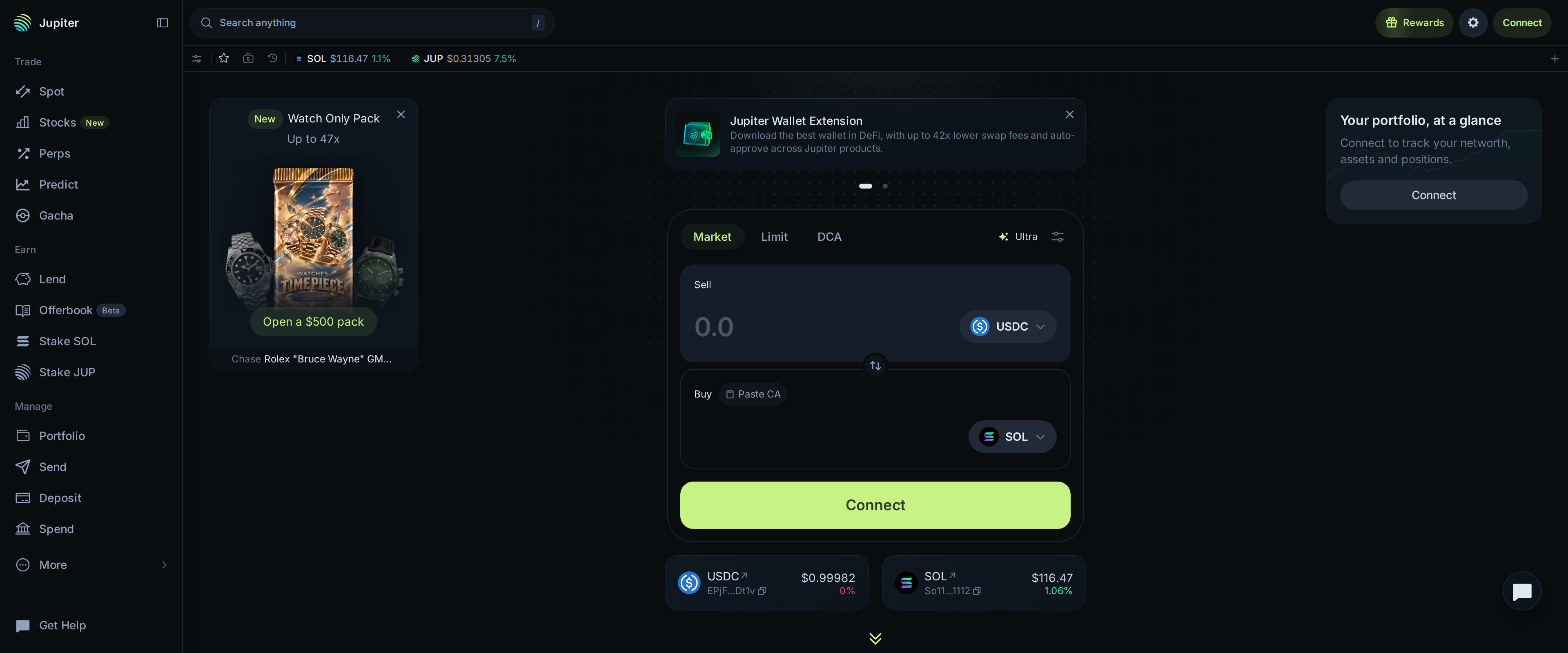
On a $500 USDC-to-SOL swap during our testing, the quoted price beat a single-venue quote we pulled for comparison by a small but real margin, consistent with what the meta-aggregation model promises: checking more routes finds a better price more often than checking one.
We repeated the same comparison on a $50 swap and a $5,000 swap to see whether the advantage held at different sizes. The gap narrowed on the small trade, where network fees make up a larger share of the total cost regardless of routing, and widened on the larger one, where a single venue's order book started showing real price impact that Jupiter's split routing avoided. That pattern matches what an aggregator is supposed to do: save the least on tiny trades and the most on the ones that would otherwise move a thin order book.
The 250x leverage sitting one tab over
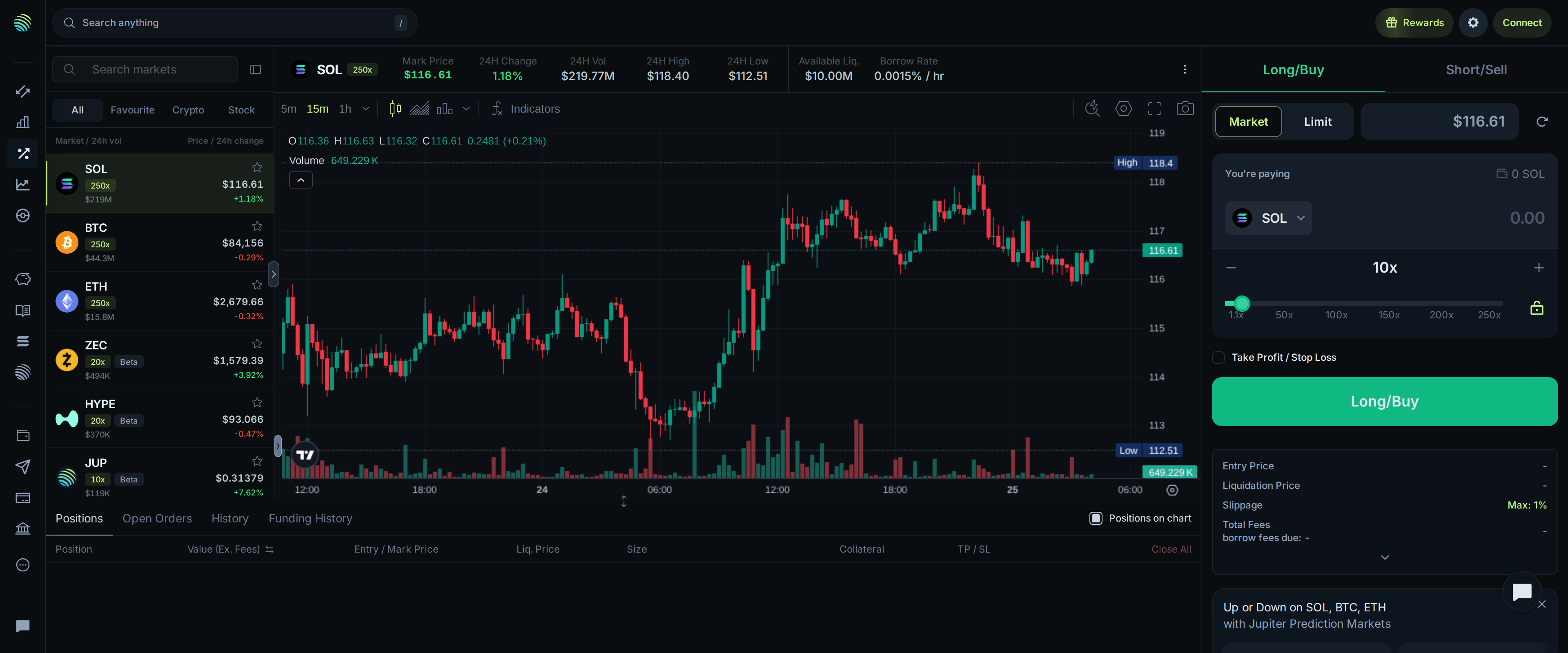
Click from Spot to Perps on the same interface and the leverage slider on SOL, BTC or ETH goes all the way to 250x. We opened a small 10x long on SOL to see the mechanics, and the liquidation price sat close enough to the entry that a routine five-minute candle could have closed the position. Available liquidity and borrow rates are shown clearly on the same screen, which is good transparency, but transparency about a dangerous tool is not the same as protection from it. A newcomer dragging that slider without understanding liquidation math can lose a full position on a move that would barely register on a spot chart.
Self-custody cuts both ways
Every swap and every perpetual position runs through the connected wallet directly, and Jupiter never holds user funds at any point, which is the strongest argument in its favor: there is no exchange balance to freeze and no custodian to fail. It is also the sharpest edge for a beginner. In April 2024, phishing sites impersonating Jupiter's own domain cost users roughly $50 million combined, and independent reporting is consistent that Jupiter's smart contracts were never breached, the fake front ends were. Because the platform is non-custodial, there was no support desk that could freeze or reverse those transactions once signed.
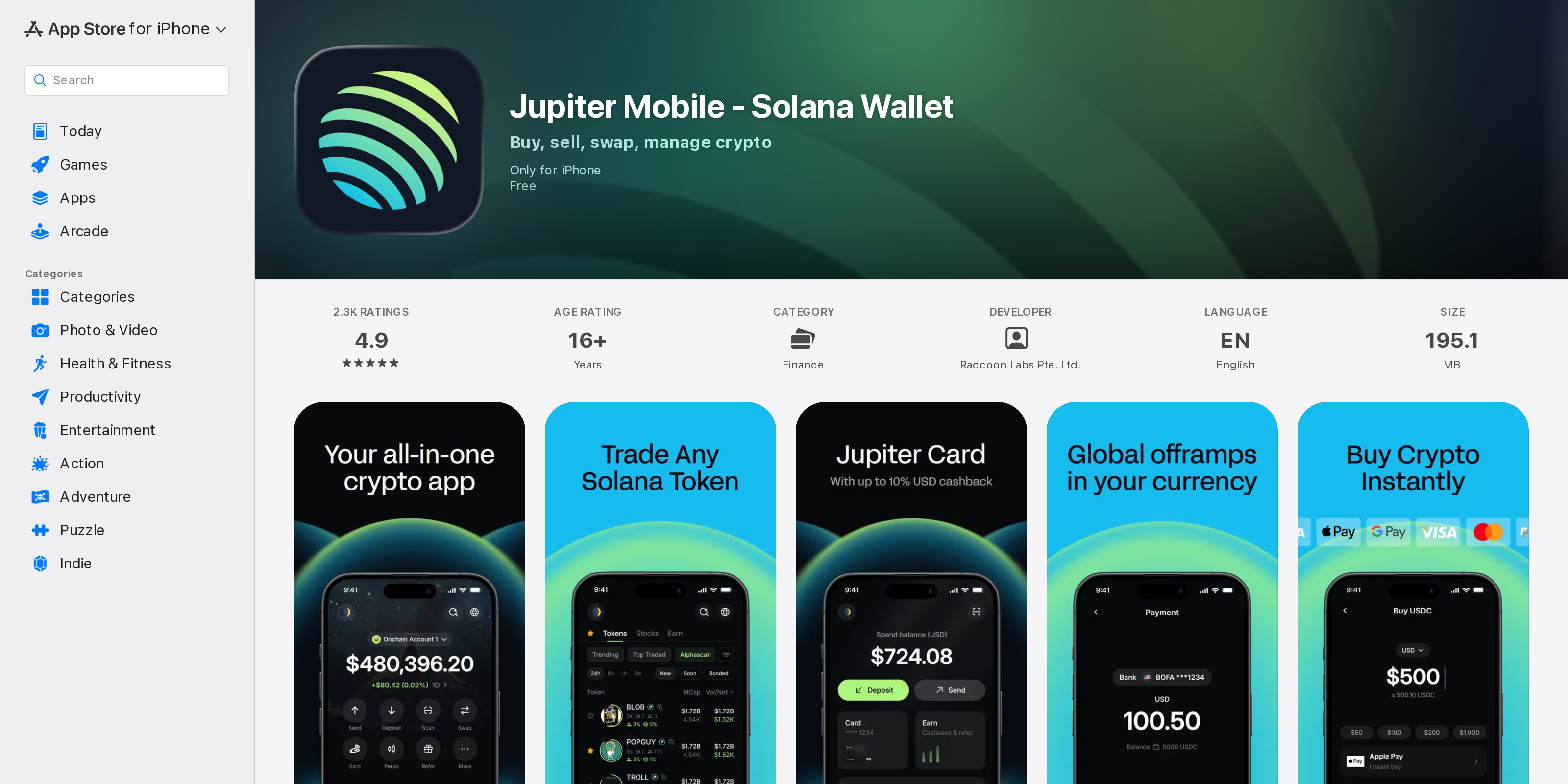
Jupiter Mobile tries to soften that risk for newcomers with email or Apple ID login instead of an immediate seed phrase, plus a built-in Web3 browser that scans sites and transactions before signing. It carries a 4.9 out of 5 rating across more than 1.1 million ratings on iOS, which is a strong signal the scanning and onboarding work as intended for most users, though it does not eliminate the underlying self-custody risk.
Our verdict
Jupiter does the one thing an aggregator is supposed to do: it finds a better swap price than picking a single Solana exchange, at fees low enough on most pairs that they barely register. That same screen puts 250x leverage and a fully self-custodial wallet connection in front of anyone who opens the app, with no account recovery and no fraud desk if a signature goes to the wrong place. Experienced Solana traders should keep using it for the routing alone. A newcomer should treat the perpetuals tab as something to learn about before touching, not the same afternoon they first connect a wallet.
Pros and cons
Pros
- Platform fees run 0 basis points on JUP, JLP and pegged-asset pairs and just 2 to 10 basis points on most others
- Meta-aggregation routes each swap across multiple venues to reduce price impact on larger trades
- The Real-Time Slippage Estimator adjusts slippage tolerance automatically instead of leaving a fixed guess
- Jupiter Mobile holds a 4.9 out of 5 rating from over 1.1 million raters and supports Apple Pay purchases without a seed phrase
Cons
- Perpetuals on SOL, BTC and ETH allow up to 250x leverage, a level that can liquidate a small adverse move in seconds
- A phishing campaign in April 2024 cost users roughly $50 million through fake sites, not a flaw in Jupiter's own contracts
- Being fully self-custodial means a lost seed phrase or a signed malicious transaction has no support line to reverse it
- Priority fees on Solana network congestion are dynamic and not shown as a fixed number before you swap
Tested and written by The Ordertide Test Desk. Published , updated . This review is not financial advice. How we review.